
Olfactory virtual reality: how smell is transforming professional training
Why adding scent to VR training improves immersion and memory, which trades benefit most and how to deploy an olfactory kit in professional training.
Virtual reality has changed the way hands-on skills are taught. Trainees can now practise on an electrical installation, in a professional kitchen or in a hazardous area with no real danger and without tying up equipment. Yet most simulations engage only two senses: sight and hearing.
In the field, however, professionals do not work with their eyes alone. A gas technician detects a leak by its smell before seeing it. A chef knows a sauce is catching before it turns black. A firefighter identifies an electrical fire by the smell of burning plastic. These olfactory signals are part of the job, and they are missing from most VR training.
Olfactory virtual reality fills that gap. This guide explains what it is, why it improves learning, which trades benefit most, and how to introduce it into a training programme.
What is olfactory virtual reality?
Olfactory virtual reality means releasing scents in sync with what is happening in the simulation. When the trainee approaches an oven in a virtual kitchen, they smell warm bread. When a leak occurs in a plant room, the characteristic smell of gas appears. When the scene changes, the smell changes with it.
In practice, it relies on three components:
- A diffuser placed close to the user’s nose, usually attached beneath the VR headset.
- Scent capsules, each containing a specific scent (kerosene, disinfectant, cut grass, coffee…).
- Software that triggers the right capsule at the right moment, driven directly by the VR application.
The technical challenge is not producing a smell but controlling it: releasing it at the exact moment, in a quantity sufficient to be perceived, then letting it fade quickly enough not to contaminate the next scene. This is what distinguishes a genuine olfactory system from a simple perfume diffuser placed in the room.
Why smell changes the way we learn
Smell is directly linked to emotion and memory
Smell holds a special place among our senses. Olfactory information is transmitted very directly to the brain structures involved in emotion and memory, in particular the amygdala and the hippocampus. The other senses first go through more processing stages.
This is often called the Proust effect, after the madeleine in In Search of Lost Time. The psychologist Rachel Herz (Brown University) studied it experimentally. She presented the same cues (a campfire, cut grass, popcorn) as a smell, an image or a sound. The result: memories evoked by the smell were markedly more emotional than those evoked by sight or hearing. A functional MRI study by the same team linked this effect to stronger activation of the amygdala.
For a trainer, the implication is simple: what is learnt with a smell is anchored more deeply, because the experience is lived more intensely.
More senses, more presence, better retention
Virtual reality research confirms this link. A landmark study by Dinh and colleagues, presented at the IEEE Virtual Reality conference in 1999, involved 322 participants. It showed that adding tactile, olfactory and auditory cues to a virtual environment increased both the sense of presence and memory of the environment. A striking detail: increasing the quality of the graphics improved neither presence nor memory.
The same study showed that a localised coffee smell helped participants remember where its source was located in the scene.
In other words, to make a simulation more memorable, adding a sense often matters more than polishing the image.
Smell also influences behaviour
Smells do not only affect memory. Research published in 2020 (de Groot et al., Behavior Research Methods) showed that participants exposed to the smell of a cleaning product in a VR environment displayed more motivated cleaning behaviour. The smell steers action, exactly as it does in a real workplace.
Other studies (Baus and Bouchard, 2017) found that an unpleasant smell strengthened the sense of presence in a virtual scene. This is an important point for training: the most useful smells from a teaching perspective are not necessarily pleasant ones. Smoke, gas, solvents, chemicals: these are precisely the warning signals that trainees need to learn to recognise.
What to bear in mind
Research also shows that a poorly chosen or poorly synchronised smell can have the opposite effect. A scent that does not match the scene, or is too strong, reminds the user that the simulation is artificial. The smell must therefore always serve the learning scenario, at the right moment and at the right intensity. This is a design task, not a gadget added at the end.
The trades that benefit most from olfactory VR
Olfactory virtual reality adds the most value wherever smell is professional information: a danger signal, a quality indicator or part of the customer experience.
Energy, gas and technical maintenance
This is the most telling use case. In France, natural gas is odourless in its pure state. Network operators add tetrahydrothiophene (THT), a sulphur compound that gives it its characteristic rotten-egg smell, precisely so that anyone can detect a leak.
Training a technician to recognise this smell, then immediately apply the correct procedure, is difficult under real conditions: you do not cause a leak in order to practise. With olfactory VR, the situation can be reproduced as many times as necessary. The same logic applies to the smell of ozone around electrical equipment, of heating oil, or of heated metal during welding.
Fire safety and crisis management
The smell of smoke, melting plastic or an overheating cable is often the first sign of a fire breaking out. Training teams to react to this signal, even before they see flames, brings the exercise closer to reality.
Healthcare and hospitals
Disinfectant, surgical spirit, latex, the sterile air of operating theatres: the hospital environment has a strong olfactory signature. Reproducing it helps students and new starters get used to this environment, and makes care simulations more credible.
Cooking, catering and hospitality
In the kitchen, smell is a working tool in its own right: cooking, freshness of produce, spices. We cover this use case in detail on our page olfactory VR for cooking. In hospitality, smell is part of the customer experience (clean linen, spa atmosphere, breakfast coffee), which makes it a lever for front-of-house training (see our hospitality page).
Perfumery and sensory professions
For professions where smell is the core skill, olfactory VR makes it possible to train in recognising notes in realistic scenarios, for example in a shop. See our perfumery page.
Construction, industry, agriculture, maritime, defence
Fresh concrete, tar, industrial solvents, fertiliser, sea air, gunpowder: every sector has its own field smells. Integrating them makes the simulation truer to real operating conditions. You can browse all the available worlds in our scent library.
The practical benefits for a training organisation
Beyond the research, olfactory VR meets very operational needs:
- Practise dangerous situations without danger. A leak, a fire breaking out or a toxic product can be reproduced without any real exposure.
- Repeat as often as necessary. An olfactory scenario can be replayed identically, which makes assessment and progression easier.
- Remember better. A more intense and more complete experience leaves a more lasting trace, as the studies cited above show.
- Prepare for the real field. Trainees encounter in training the smells they will meet on the job, instead of discovering them for the first time in an emergency.
- Engage trainees. A multisensory simulation surprises and holds attention, which matters in training sessions that can be long.
How to deploy olfactory VR in a training programme
1. Start from the job skill, not the technology
The first question is not “which smells do we have?” but “which smells must the trainee be able to recognise or deal with in their job?”. Each scent must correspond to a learning objective: a warning signal to spot, a quality check to carry out, an atmosphere to master.
2. Choose equipment suited to intensive use
In training, equipment passes from head to head, several hours a day. A few criteria really matter:
- Weight and comfort: the diffuser should go unnoticed under the headset.
- Compatibility with the headsets the organisation already uses.
- Battery life sufficient for half a day of sessions.
- Capsules that are easy to replace between two groups or two scenarios.
- Simple software integration for the teams developing the content.
3. Synchronise the smells with the scenario
The smell must be triggered by the simulation itself: the trainee opens a door, approaches a piece of equipment, makes a mistake. A software development kit (SDK) compatible with the simulation’s engine makes it possible to programme these triggers precisely.
4. Adjust the dose and test with real trainees
A smell that is too strong tires and distracts. A smell that is too weak goes unnoticed. The scenario must be tested with real users and the intensity and duration of release adjusted before deployment.
5. Plan for ventilation and hygiene
Between two sessions, the room must be aired to prevent smells from building up. The same hygiene rules as for VR headsets must also be applied. It is useful to make the safety data sheets (SDS) for the scents used available.
Aromadive: the olfactory kit designed for training
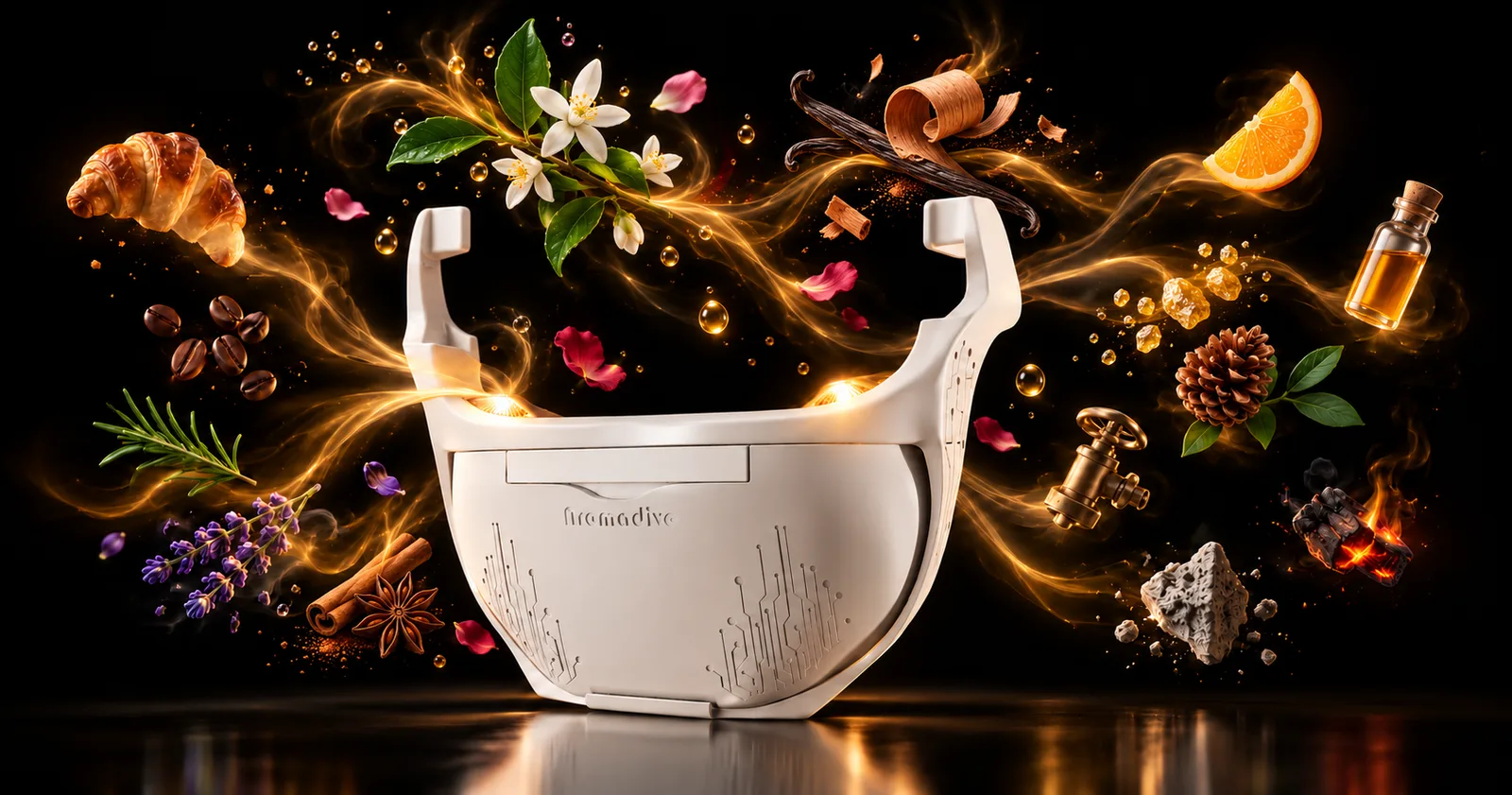
At i-Oasis, we design virtual reality training from our 2,700 m² VR park in Villeneuve-Saint-Georges. It was while developing this training that we created Aromadive, an olfactory kit built for the constraints of professional use:
- A compact, lightweight format that clips beneath the VR headset.
- Compatibility with a wide range of headsets on the market.
- A wireless connection via Bluetooth.
- Around 4 hours of battery life thanks to a rechargeable lithium-ion battery.
- Replaceable capsules with release synchronised to the scene.
- A Unity-compatible SDK to integrate smells into your own simulations.
- A library of 209 scents across 18 professional domains (energy, healthcare, cooking, construction, maritime, chemicals…), with the option of creating bespoke scents.
You can try the kit under real conditions by booking a demonstration or view our pricing.
Frequently asked questions
Does olfactory virtual reality work with all VR headsets?
It depends on the system. The Aromadive kit was designed to attach beneath a wide range of headsets on the market. For a specific model, the simplest option is to contact us or to test it during a demonstration.
Do smells linger in the room or on the headset?
Well-dosed release, localised close to the nose, greatly limits persistence. Airing the room between sessions is generally enough to return to a neutral baseline.
Are the scents safe?
The scents reproduce the smell of a situation (smoke, gas, fuel), not the hazardous product itself. The safety data sheets (SDS) for Aromadive scents are available on the scents page.
Can smells be added to an existing VR training course?
Yes, if the application can be modified. With a Unity-compatible SDK, developers add scent triggers at the key moments of the scenario, without rebuilding the simulation.
Can a bespoke smell be created?
Yes. If your profession relies on a specific smell that is not in the library, a custom scent can be developed.
Does smell really improve memory?
Several studies show that it does. Memories associated with a smell are more emotionally charged (work by Rachel Herz). In virtual reality, adding olfactory, auditory and tactile cues increases presence and memory of the environment (Dinh et al., 1999). The smell must, however, be consistent with the scene to produce this effect.
Sources
- Dinh, H. Q., Walker, N., Hodges, L. F., Song, C., Kobayashi, A. (1999). Evaluating the importance of multi-sensory input on memory and the sense of presence in virtual environments. Proceedings IEEE Virtual Reality, 222–228. IEEE Xplore
- Herz, R. S. (2004). A naturalistic analysis of autobiographical memories triggered by olfactory, visual and auditory stimuli. Chemical Senses, 29(3), 217–224. Oxford Academic
- Herz, R. S., Eliassen, J., Beland, S., Souza, T. (2004). Neuroimaging evidence for the emotional potency of odor-evoked memory. Neuropsychologia, 42, 371–378. ScienceDirect
- Baus, O., Bouchard, S. (2017). Exposure to an unpleasant odour increases the sense of Presence in virtual reality. Virtual Reality. Springer
- Literature review on olfaction in VR: Olfactory Perception and Presence in a Virtual Reality Food Environment, Frontiers in Virtual Reality (2020). Frontiers
- Natural gas odorisation in France (THT): ENGIE, Teréga